Root Canal Treatment in Coimbatore: Why a Staged Approach Can Help Protect Your Tooth
Tooth pain can create one of the most common dental fears: “Will I have to remove this tooth?”
The good news is that an infected or severely inflamed tooth may sometimes be treated and preserved with root canal treatment.
But root canal treatment is not just about cleaning a tooth and filling it.
The long-term success of treatment also depends on controlling infection, assessing how the tooth responds, preserving as much healthy tooth structure as possible and protecting the restored tooth from fracture.
At Sri Sai Dental Clinic on Avinashi Road, Coimbatore, our endodontic treatment philosophy follows a structured, staged approach when clinically appropriate.
The protocol described in our clinical workflow emphasizes four important principles:
control infection first, reassess symptoms, reinforce conservatively and protect the tooth with a definitive restoration. 10-15 Two-Visit Endodontic Work…
What Happens Inside a Tooth That Needs Root Canal Treatment?
Inside every healthy tooth is a space containing the dental pulp, which contains nerves and blood vessels.
When decay, bacterial infection or other damage affects this internal tissue, inflammation and infection can develop.
The resulting symptoms can vary considerably from patient to patient.
Some people experience persistent pain. Others may have pain when biting, sensitivity or recurrent symptoms from a tooth that has previously been treated.
A clinical examination is therefore essential to determine what is actually happening and whether root canal treatment is appropriate.
Why Doesn’t Every Root Canal Have to Be Completed Immediately?
One of the important concepts in our two-visit protocol is staging the treatment according to the tooth’s clinical response.
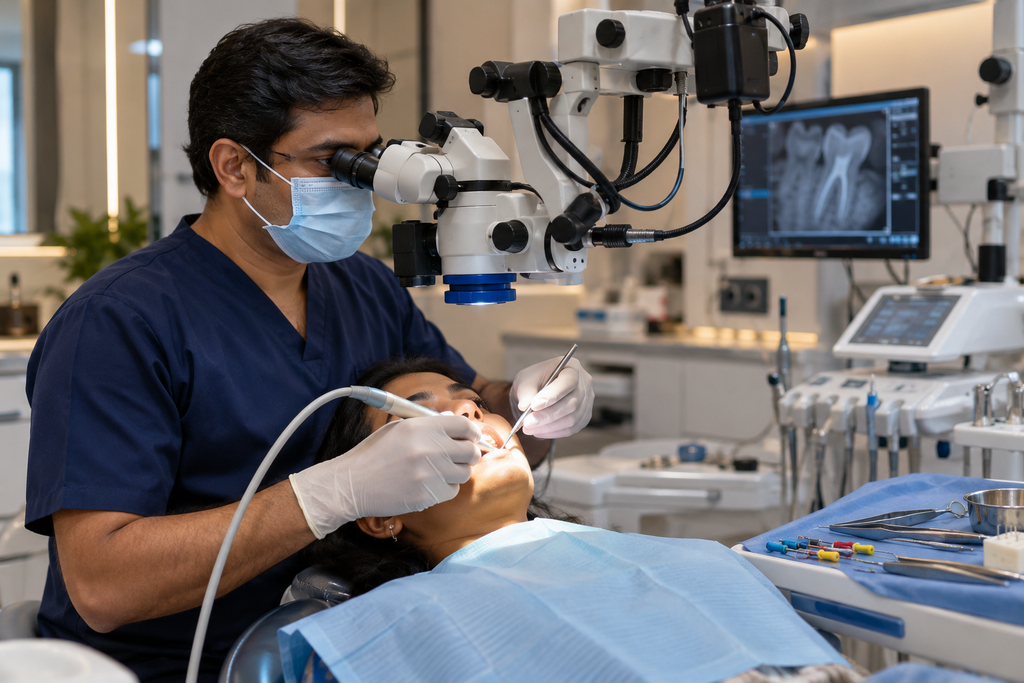
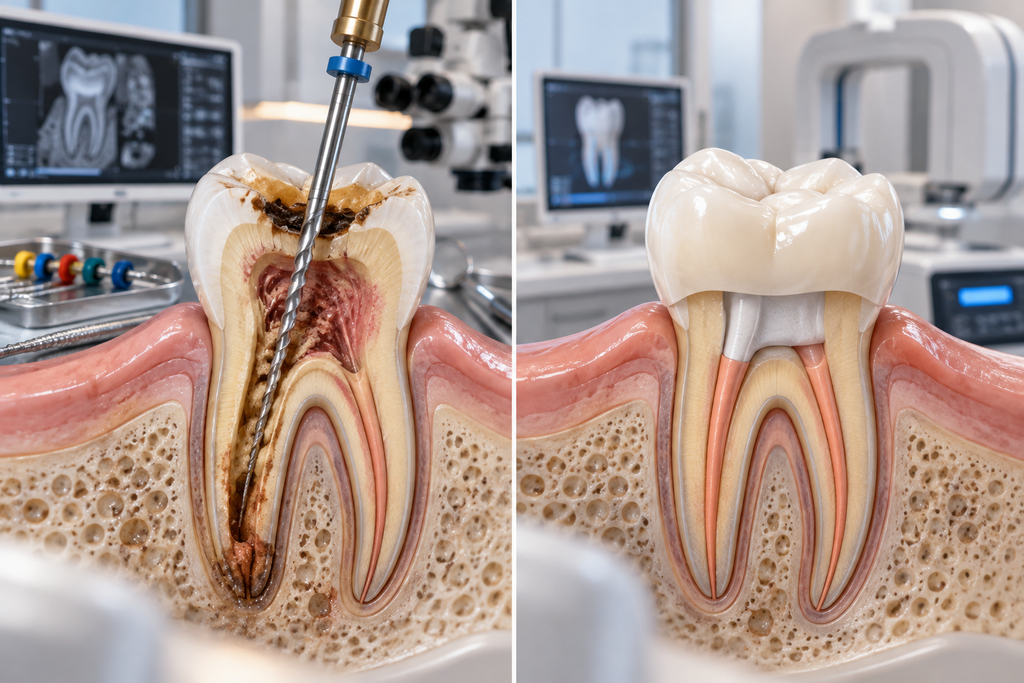
During the first visit, the canals are cleaned and managed, and intracanal medication may be placed to help reduce bacterial load and inflammation.
The tooth is then reassessed.
If symptoms have settled appropriately, definitive root canal treatment can proceed. 10-15 Two-Visit Endodontic Work…
This is particularly relevant when infection and pain need to be controlled before permanent sealing.
The clinical protocol specifically identifies the absence of significant active pain as an important decision gate before final obturation. 10-15 Two-Visit Endodontic Work…
Visit 1: Infection and Pain Control
The first appointment focuses on managing the problem inside the tooth.
The canals are cleaned and infected material is addressed. Intracanal medication may then be used between appointments.
The objective is to reduce the bacterial burden and inflammation associated with the infected root canal system and surrounding tissues.
The patient is then monitored for improvement.
This is an important distinction: the first appointment is not necessarily about rushing to the final filling.
The priority is establishing appropriate infection control and allowing the tooth to respond.
Visit 2: Reassessment and Definitive Root Canal Treatment
At the next appointment, the tooth is reassessed.
If the patient’s pain and symptoms have settled appropriately, the root canal can be completed.
The canals are permanently filled, or obturated, and the tooth is then prepared for restoration.
This staged approach provides a clinical decision point between initial infection management and definitive treatment. 10-15 Two-Visit Endodontic Work…
What Is a Core After Root Canal Treatment?
Once root canal treatment is completed, the tooth may have lost a considerable amount of its original structure.
A core buildup can be used to reconstruct the internal portion of the tooth and provide a foundation for the final restoration.
However, this is where another important decision has to be made:
Does Every Root Canal Tooth Need a Post?
No.
This is one of the most important principles of the treatment protocol.
A post is essentially a reinforcing/retentive component placed within the root canal space to help retain a core when there is insufficient remaining tooth structure.
However, placing a post when it is not required can introduce additional structural stress.
The protocol therefore recommends using a post only when the remaining coronal tooth structure is insufficient to retain the core. If an adhesive core can provide adequate retention, unnecessary post placement should be avoided. 10-15 Two-Visit Endodontic Work…
This is an example of a conservative treatment philosophy:
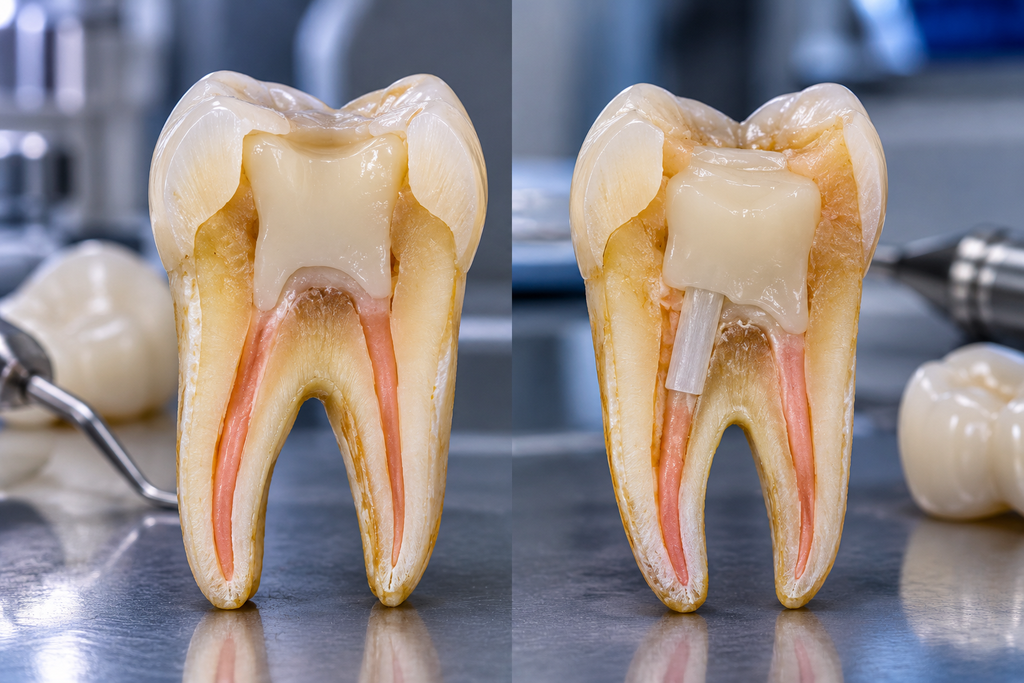
Use reinforcement when it is necessary—not simply because the tooth has had a root canal.
Why Is the Crown So Important After Root Canal Treatment?
Completing the root canal does not mean the treatment journey is finished.
A tooth that has undergone root canal treatment can remain vulnerable to fracture, particularly when substantial tooth structure has already been lost.
This is why definitive restoration is an important part of the overall treatment plan.
Once the core buildup is completed and the clinical situation is appropriate, the tooth can be prepared for its final crown.
The protocol targets crown placement at approximately one week after the core buildup, helping protect the restored tooth from functional forces. 10-15 Two-Visit Endodontic Work…
A Simple Way to Understand Our Approach
Think of root canal treatment as a sequence rather than a single procedure:
1. Control
Clean the infected canals and manage infection and inflammation.
2. Reassess
Allow the tooth to respond and evaluate whether symptoms have settled.
3. Complete
Perform definitive root canal obturation when clinically appropriate.
4. Rebuild
Restore lost tooth structure with an appropriate core, using a post only when indicated.
5. Protect
Place the definitive crown to reduce the risk of fracture.
This sequence reflects the core clinical philosophy outlined in our protocol: infection control first, conservative structural reinforcement and timely definitive restoration. 10-15 Two-Visit Endodontic Work…
How Digital Dentistry Can Support Dental Treatment
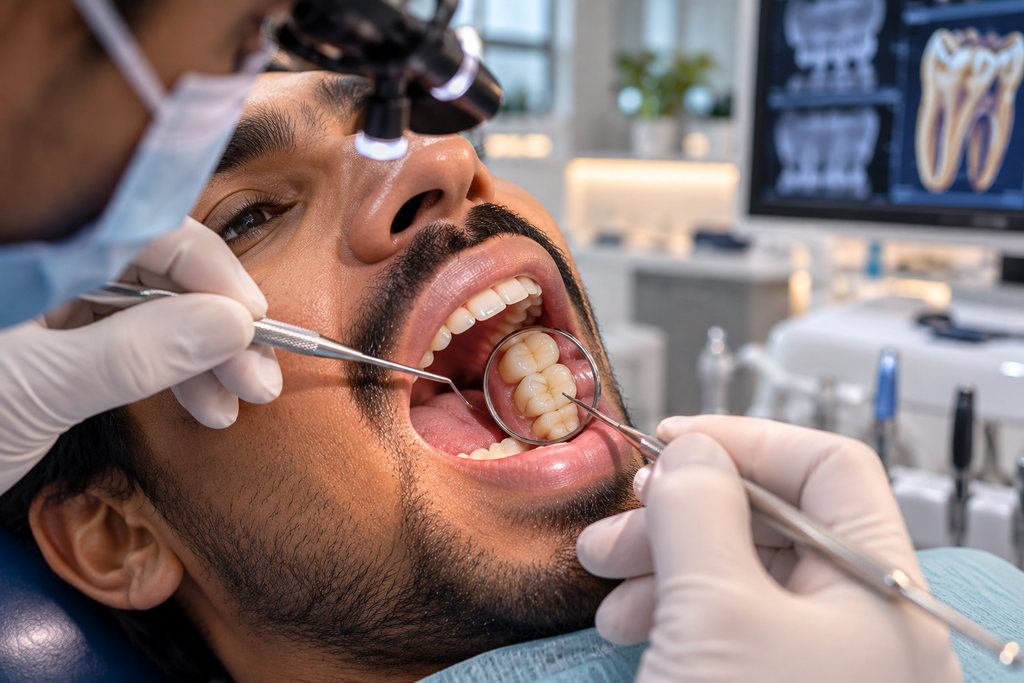
Modern dentistry has increasingly moved toward digital diagnosis, treatment planning and documentation.
At Sri Sai Dental Clinic, our available technology includes CBCT imaging, intraoral scanners, 3D printing and digital dental workflows.
These technologies can be incorporated into treatment planning when clinically indicated.
For example, CBCT may provide three-dimensional information when conventional dental radiographs are insufficient for a particular diagnostic or treatment-planning question.
Our digital capabilities are part of a broader goal: combining appropriate technology with sound clinical decision-making rather than using technology simply for its own sake.
Why Choose Sri Sai Dental Clinic in Coimbatore?
Sri Sai Dental Clinic is located on Avinashi Road, Coimbatore, and provides multidisciplinary dental care supported by a team that includes prosthodontic, implantology, maxillofacial, preventive and cosmetic dental expertise.
Our approach to complex dental treatment is based on planning the restoration as part of the overall treatment—not treating the root canal as an isolated procedure.
This becomes particularly important when significant tooth structure has been lost and decisions regarding core buildup, post placement and crown protection are required.
For patients considering root canal treatment in Coimbatore, a detailed examination can help determine whether the tooth can be predictably preserved and what restorative steps may be necessary afterwards.
When Should You See a Dentist?
Don’t wait until dental pain becomes severe.
If you experience persistent pain, discomfort while chewing, prolonged sensitivity or recurring symptoms from a previously treated tooth, a dental evaluation is appropriate.
The earlier the problem is assessed, the sooner your dentist can determine the available treatment options.
Conclusion: Root Canal Treatment Is About More Than Cleaning the Tooth
A successful root canal treatment plan doesn’t end when the canals are filled.
The treatment needs to consider:
- Infection control
- Symptom resolution
- Conservative preservation of tooth structure
- Appropriate core restoration
- Selective use of a post
- Timely crown protection
At Sri Sai Dental Clinic, Avinashi Road, Coimbatore, our staged approach is designed around these principles.
If you have been advised to undergo root canal treatment or are experiencing persistent tooth pain, contact our clinic for an evaluation.
Sri Sai Dental Clinic – Avinashi Road, Coimbatore
Phone: +91 94427 09568
Website: www.srisaidentalclinic.com
www.srisaiclinic.com