Category: Uncategorized

  • Why Some Root Canal Treatments Are Done in Two Visits: A Staged Approach to Infection Control and Healing

    Understanding how cleaning, medication and symptom-based completion can help protect a compromised tooth

    Tooth pain caused by deep decay can be distressing, particularly when the infection has reached the pulp or tissues around the root. Many patients assume that root canal treatment simply means cleaning the tooth and filling it on the same day.

    However, some infected and inflamed teeth may benefit from a staged, two-visit approach.

    At Sri Sai Dental Clinic, Avinashi Road, Coimbatore, the treatment plan for an affected tooth is determined according to its clinical condition, symptoms, anatomy and response to initial treatment. In appropriate cases, treatment may involve an initial appointment focused on cleaning and infection control, followed by a second appointment for definitive root canal filling once the symptoms have settled.

    The objective is straightforward:

    Control infection first. Allow the tissues to settle. Then complete the root canal with an appropriate seal and restoration.


    Why Might a Root Canal Be Planned Over Two Visits?

    A tooth with deep caries may develop significant inflammation of the pulp or pulpal necrosis. Infection can also extend through the root canal system towards the tissues around the root.

    In these situations, immediately completing the root canal may not always be the preferred approach.

    A staged treatment protocol allows the clinician to:

    • Assess the extent of the problem
    • Clean and disinfect the canal system
    • Reduce the microbial load
    • Place intracanal medication
    • Monitor the patient’s symptoms
    • Reassess the tooth before definitive obturation

    The underlying principle is to establish appropriate infection control before permanently sealing the root canal system.


    Step 1: Diagnosis and Treatment Planning

    The first stage is understanding exactly what is happening inside and around the tooth.

    A periapical radiograph is an important diagnostic tool for evaluating the tooth and surrounding tissues.

    When the anatomy or pathology cannot be adequately understood from conventional imaging, CBCT may be considered when clinically justified and available.

    CBCT can provide additional three-dimensional information regarding:

    • Root and canal anatomy
    • Periapical changes
    • Anatomical complexity
    • The relationship of the tooth to important surrounding structures

    The purpose of imaging is not simply to obtain another picture. It is to help the clinician understand the anatomy and identify potential treatment considerations before starting the procedure.
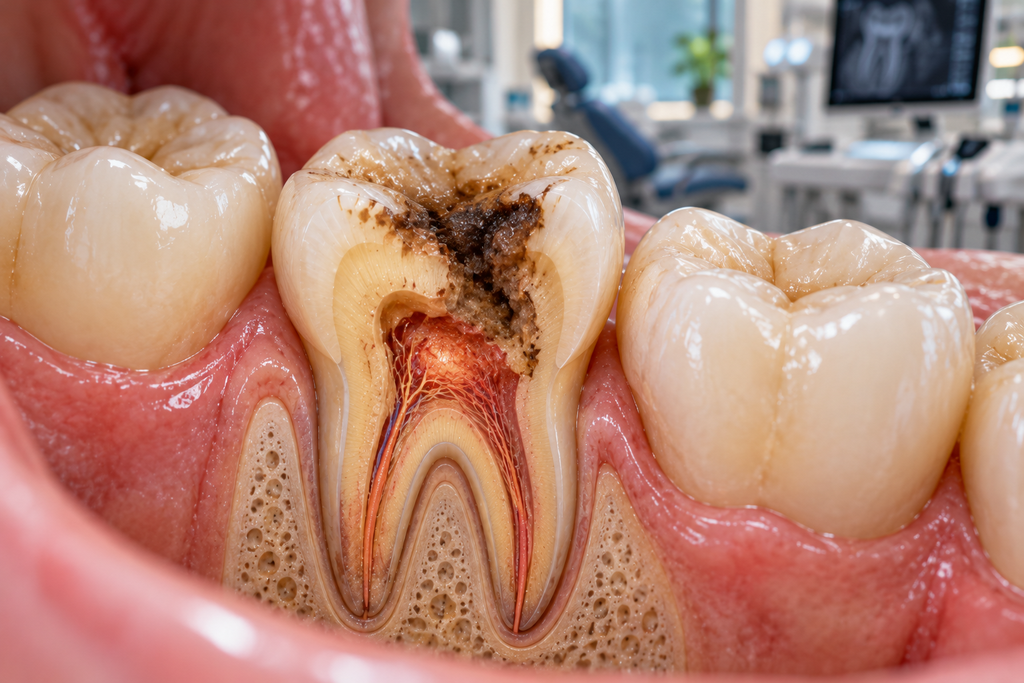
    Deep dental caries affecting a tooth requiring root canal treatment

    Step 2: Accessing the Infected Canal System

    Once the tooth has been diagnosed and treatment is planned, an access opening is made to reach the pulp chamber.

    The clinician then works towards establishing access to the root canal system and the appropriate working length.

    This stage allows the infected and inflamed tissue within the canal system to be addressed.

    The treatment objective is not simply to create an opening in the tooth.

    It is to gain controlled access to the canal system so that effective cleaning and disinfection can take place.
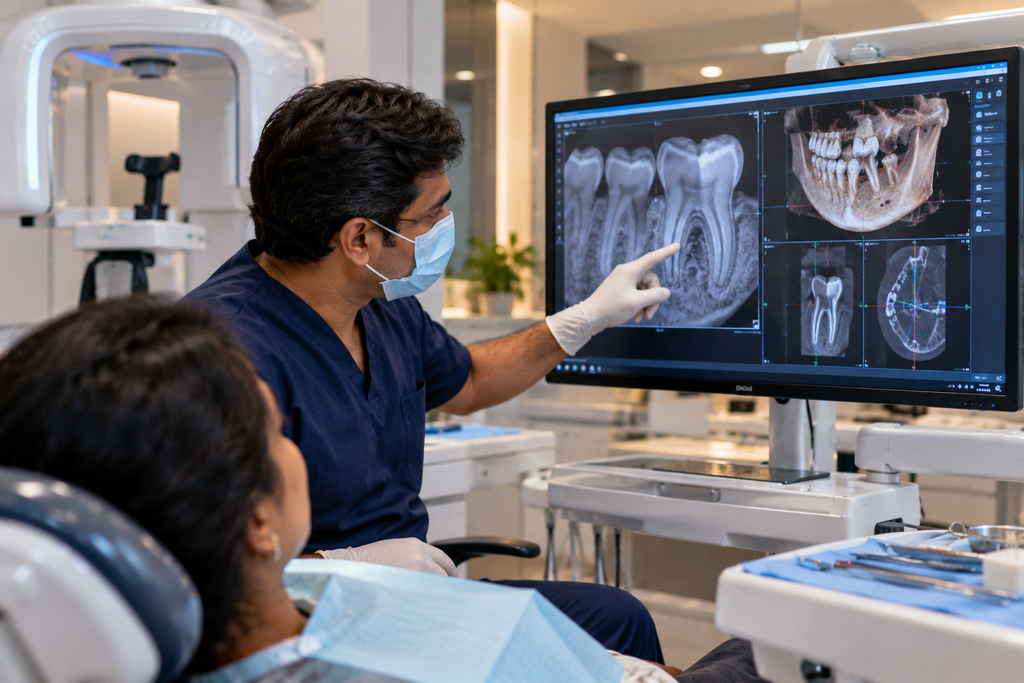
    Periapical X-ray and CBCT assessment before root canal treatment

    Step 3: Biomechanical Preparation and Irrigation

    One of the most important stages of root canal treatment is biomechanical preparation (BMP).

    During this stage, the canals are prepared to remove infected tissue and reduce the microbial load within the root canal system.

    Irrigation plays an important role alongside mechanical preparation.

    The overall objective is to achieve thorough cleaning of the canal system, including attention to areas that may be difficult to reach mechanically.

    Particular attention is given to the apical portion of the canal, while respecting the surrounding anatomy and avoiding unwanted extrusion of materials beyond the root.

    This combination of mechanical preparation and irrigation forms an important part of infection control.
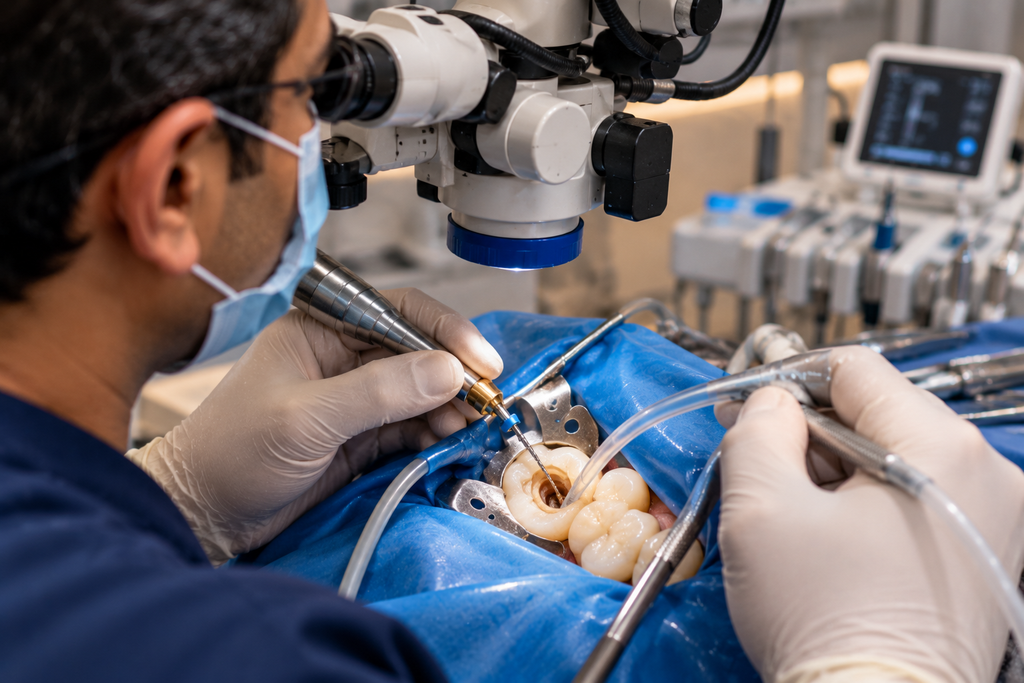
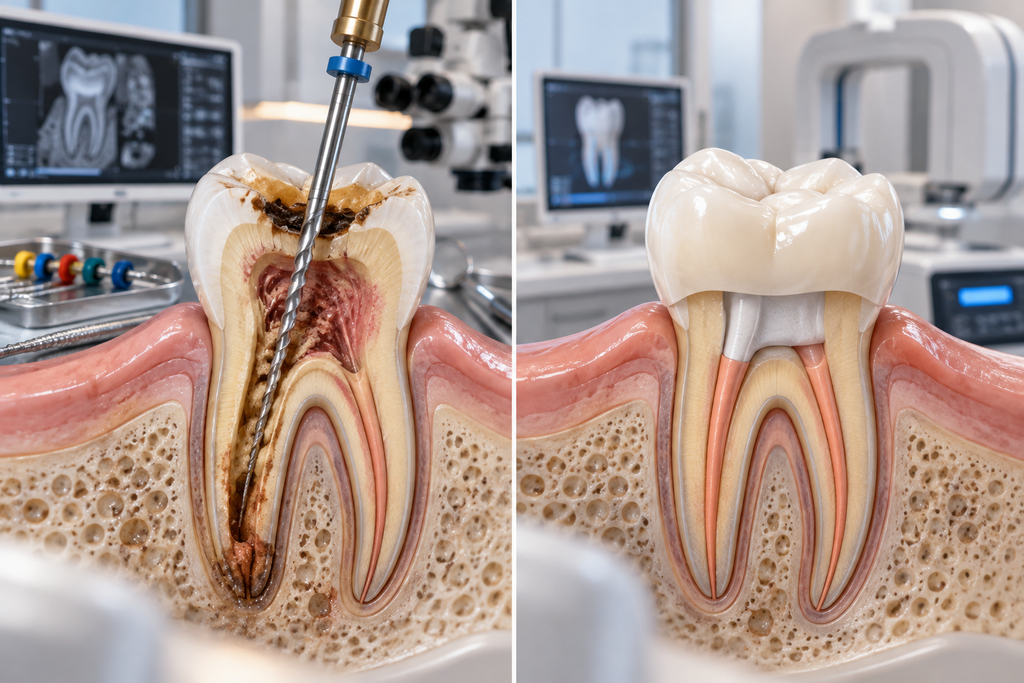
    Biomechanical preparation and irrigation during the first visit of root canal treatment

    Step 4: Intracanal Medication Between Visits

    After the initial cleaning and irrigation, an intracanal medicament may be placed inside the prepared canal.

    The protocol describes the use of a calcium-based intracanal medicament to assist with disinfection and management of inflammation between appointments.

    The tooth is then temporarily sealed.

    This creates an interval during which the treated tooth and surrounding tissues can settle.

    The patient is also given appropriate instructions regarding symptoms and pain monitoring.
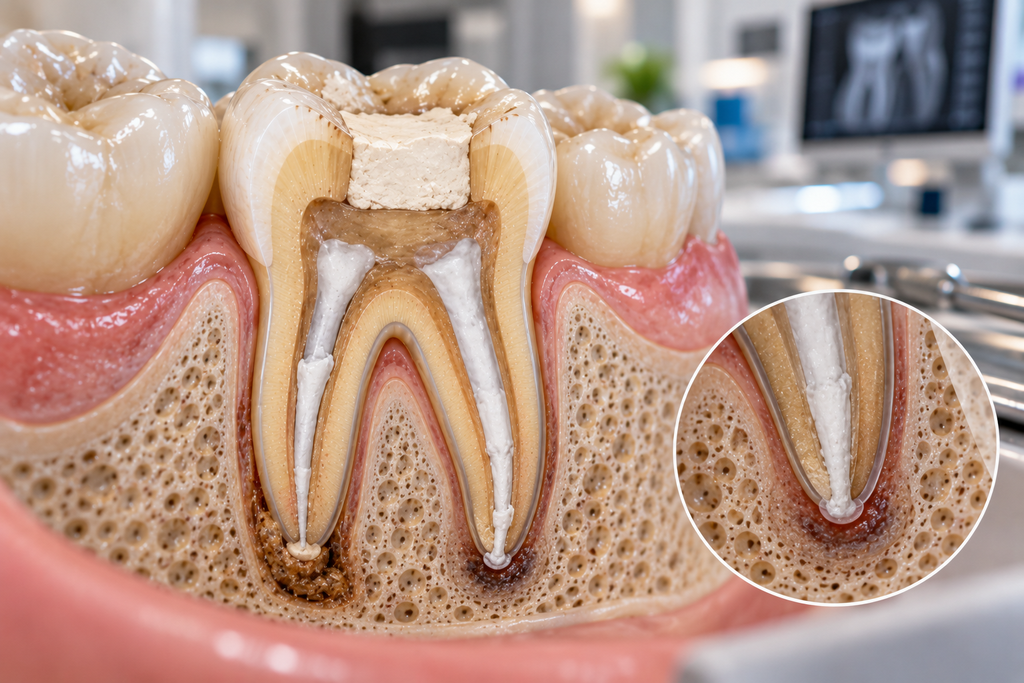
    Intracanal medication placed during staged two-visit root canal treatment

    Why Not Fill the Root Canal Immediately?

    This is one of the most important questions patients may have.

    In an inflamed or infected tooth, the clinician may want to first establish better control of the infection and assess how the tooth responds.

    The two-visit approach therefore introduces an important clinical decision gate.

    At the second appointment, the symptoms are reassessed.

    If the pain and symptoms have resolved:

    The canals can be re-cleaned and definitive root canal treatment can proceed.

    If significant symptoms remain:

    The intracanal medication may be renewed and definitive obturation may be deferred until the tooth has settled appropriately.

    This symptom-based decision-making is an important feature of the staged protocol.


    Step 5: Second Visit — Re-Cleaning and Obturation

    When the tooth has responded appropriately, the treatment proceeds to its definitive stage.

    The canals are re-cleaned and prepared for obturation, which is the process of filling the prepared root canal system.

    The objective is to achieve an effective, fluid-tight seal throughout the treated canal system.

    A good seal is important because spaces or leakage pathways can allow microorganisms to persist or re-enter the treated canal system.

    In simple terms, the final filling is intended to close the treated canal system and reduce the opportunity for reinfection.
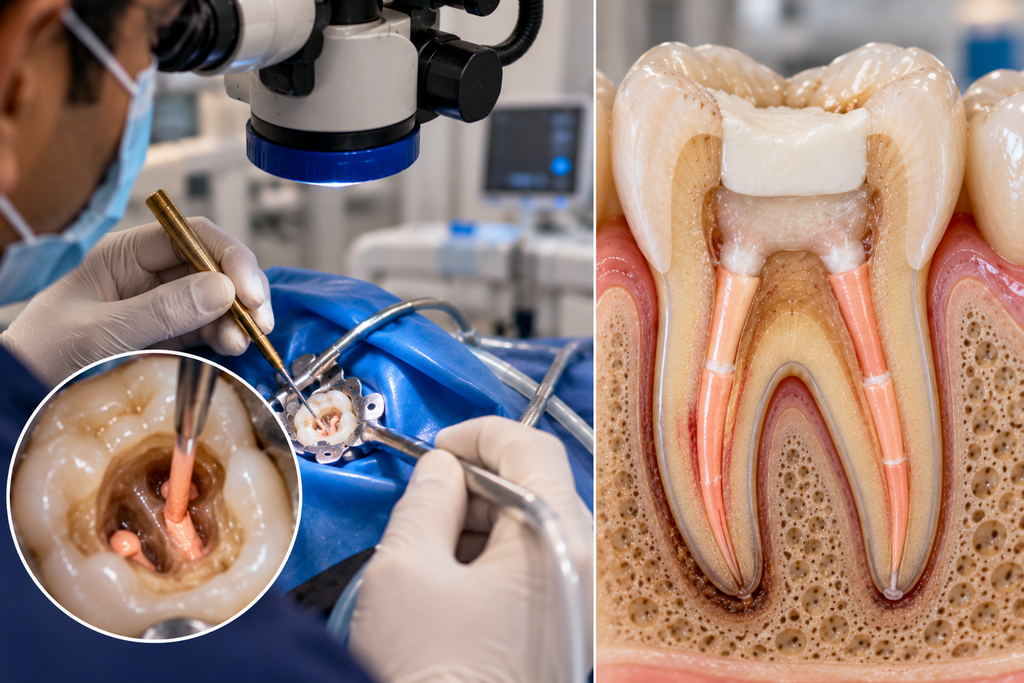
    Root canal obturation creating a definitive seal during the second visit

    The Importance of Apical Anatomy

    The area around the root tip, or apical region, requires particular attention during endodontic treatment.

    The clinician must consider the anatomy of the apical third and the relationship of the tooth to surrounding structures.

    The protocol specifically highlights the importance of respecting vascular proximity and apical anatomy.

    This helps guide treatment decisions and minimize the risk associated with extrusion of materials or unnecessary irritation of surrounding tissues.

    Careful diagnosis and treatment planning are therefore important components of predictable endodontic care.


    What Happens If the Tooth Is Still Painful at the Second Visit?

    Persistent symptoms do not necessarily mean that the treatment has failed.

    The staged protocol specifically uses the patient’s clinical response as a decision point.

    If significant pain or symptoms remain, definitive obturation can be postponed and intracanal medication may be continued or renewed.

    The objective is to avoid rushing into permanent sealing when the clinical condition indicates that further infection control may be necessary.

    This is an important distinction:

    The second appointment is not simply a predetermined date to fill the tooth. It is a reassessment point.


    Why Is Thorough Disinfection So Important?

    A root canal system can contain microorganisms and infected tissue that contribute to inflammation and persistent symptoms.

    If disinfection is inadequate, residual infection may contribute to continued symptoms or treatment complications.

    The staged approach therefore emphasizes:

    Diagnosis → Access → Cleaning → Irrigation → Medication → Reassessment → Re-cleaning → Obturation

    Each stage has a specific purpose.

    The overall objective is to reduce microbial contamination and then create an effective seal after the tooth has responded appropriately.


    What Happens After Root Canal Treatment?

    Completing the root canal is not necessarily the end of the treatment process.

    The remaining tooth structure needs to be evaluated and restored appropriately.

    Depending on the amount of tooth structure remaining, the tooth may require a core buildup and definitive crown for protection.

    Importantly, as discussed in our restorative protocol, not every root-canal-treated tooth automatically requires a post. A post is considered when the remaining tooth structure is insufficient to retain the core.

    The final restorative plan should therefore be determined according to the individual tooth rather than following a one-size-fits-all approach.


    Why Choose Sri Sai Dental Clinic for Root Canal Treatment in Coimbatore?

    At Sri Sai Dental Clinic, Avinashi Road, Coimbatore, our approach to endodontic treatment combines clinical assessment, appropriate imaging, structured treatment sequencing and restorative planning.

    Our clinic has access to advanced digital dental technology, including:

    • CBCT imaging
    • Intraoral scanning
    • Digital dental workflows
    • 3D printing technology
    • Advanced treatment-planning capabilities

    These technologies are used when clinically appropriate to support diagnosis and treatment planning.

    Our multidisciplinary dental team includes expertise in prosthodontics, implantology, maxillofacial surgery, preventive dentistry and cosmetic dentistry, allowing restorative requirements to be considered alongside the endodontic treatment.


    Is a Two-Visit Root Canal Better for Everyone?

    Not necessarily.

    The number of appointments required for root canal treatment depends on the individual tooth, its condition, symptoms, anatomy and clinical response.

    The two-visit protocol described here is particularly focused on cases where infection, inflammation and symptoms need to be controlled before definitive obturation.

    Treatment should therefore be individualized rather than assuming that every root canal must be completed in one visit or exactly two visits.


    Frequently Asked Questions

    Does every root canal require two visits?

    No. The number of visits depends on the clinical condition of the tooth and the treatment strategy selected by the dentist.

    Why is medication placed inside the tooth between visits?

    Intracanal medication can be used to assist with disinfection and management of inflammation between appointments.

    What happens if my tooth still hurts at the second visit?

    The tooth may be reassessed and intracanal medication may be continued or renewed rather than proceeding immediately to definitive obturation.

    Is CBCT required for every root canal?

    No. A periapical radiograph is an important primary diagnostic tool. CBCT may be considered when additional three-dimensional information about anatomy, pathology or surrounding structures is clinically justified.

    What happens after the root canal is completed?

    The tooth is evaluated for appropriate restoration. Depending on the remaining tooth structure, a core restoration and definitive crown may be recommended to protect the tooth.


    Conclusion

    A root canal is more than simply filling an empty space inside a tooth.

    For an infected or significantly inflamed tooth, successful management involves accurate diagnosis, controlled access, thorough biomechanical preparation, irrigation, appropriate intracanal medication, symptom reassessment and effective definitive obturation.

    A two-visit approach can provide an important opportunity to assess the tooth’s response before permanently sealing the root canal system.

    At Sri Sai Dental Clinic, Avinashi Road, Coimbatore, our aim is to approach each tooth according to its individual clinical requirements while prioritizing infection control, preservation of the natural tooth and appropriate long-term restoration.

    Experiencing persistent tooth pain? Don’t wait for the problem to worsen. Consult our dental team for an evaluation.

    Sri Sai Dental Clinic
    No. 2, Vetrivel Nagar, Civil Aerodrome Post, Avinashi Road, Coimbatore – 641014
    Phone: +91 94427 09568
    Visit Sri Sai Dental Clinic

  • Root Canal Treatment in Coimbatore: A Carefully Staged Approach to Saving Your Natural Tooth

    Root Canal Treatment in Coimbatore: Why a Staged Approach Can Help Protect Your Tooth

    Tooth pain can create one of the most common dental fears: “Will I have to remove this tooth?”

    The good news is that an infected or severely inflamed tooth may sometimes be treated and preserved with root canal treatment.

    But root canal treatment is not just about cleaning a tooth and filling it.

    The long-term success of treatment also depends on controlling infection, assessing how the tooth responds, preserving as much healthy tooth structure as possible and protecting the restored tooth from fracture.

    At Sri Sai Dental Clinic on Avinashi Road, Coimbatore, our endodontic treatment philosophy follows a structured, staged approach when clinically appropriate.

    The protocol described in our clinical workflow emphasizes four important principles:

    control infection first, reassess symptoms, reinforce conservatively and protect the tooth with a definitive restoration. 10-15 Two-Visit Endodontic Work…


    What Happens Inside a Tooth That Needs Root Canal Treatment?

    Inside every healthy tooth is a space containing the dental pulp, which contains nerves and blood vessels.

    When decay, bacterial infection or other damage affects this internal tissue, inflammation and infection can develop.

    The resulting symptoms can vary considerably from patient to patient.

    Some people experience persistent pain. Others may have pain when biting, sensitivity or recurrent symptoms from a tooth that has previously been treated.

    A clinical examination is therefore essential to determine what is actually happening and whether root canal treatment is appropriate.


    Why Doesn’t Every Root Canal Have to Be Completed Immediately?

    One of the important concepts in our two-visit protocol is staging the treatment according to the tooth’s clinical response.

    During the first visit, the canals are cleaned and managed, and intracanal medication may be placed to help reduce bacterial load and inflammation.

    The tooth is then reassessed.

    If symptoms have settled appropriately, definitive root canal treatment can proceed. 10-15 Two-Visit Endodontic Work…

    This is particularly relevant when infection and pain need to be controlled before permanent sealing.

    The clinical protocol specifically identifies the absence of significant active pain as an important decision gate before final obturation. 10-15 Two-Visit Endodontic Work…


    Visit 1: Infection and Pain Control

    The first appointment focuses on managing the problem inside the tooth.

    The canals are cleaned and infected material is addressed. Intracanal medication may then be used between appointments.

    The objective is to reduce the bacterial burden and inflammation associated with the infected root canal system and surrounding tissues.

    The patient is then monitored for improvement.

    This is an important distinction: the first appointment is not necessarily about rushing to the final filling.

    The priority is establishing appropriate infection control and allowing the tooth to respond.

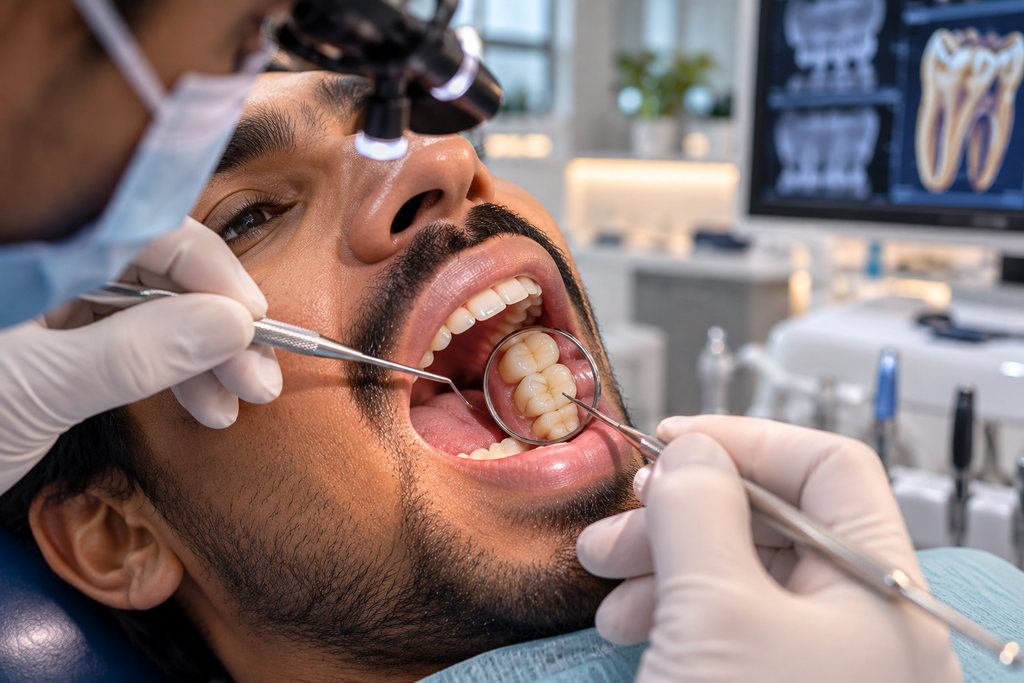
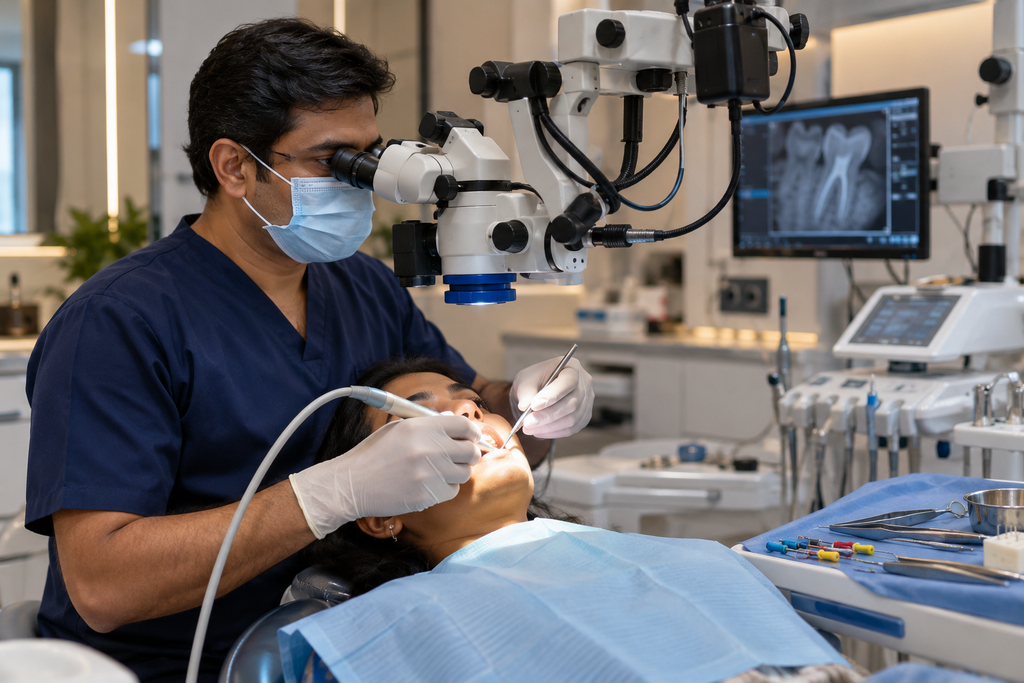
    Root canal treatment being performed at a modern dental clinic in Coimbatore

    Visit 2: Reassessment and Definitive Root Canal Treatment

    At the next appointment, the tooth is reassessed.

    If the patient’s pain and symptoms have settled appropriately, the root canal can be completed.

    The canals are permanently filled, or obturated, and the tooth is then prepared for restoration.

    This staged approach provides a clinical decision point between initial infection management and definitive treatment. 10-15 Two-Visit Endodontic Work…


    What Is a Core After Root Canal Treatment?

    Once root canal treatment is completed, the tooth may have lost a considerable amount of its original structure.

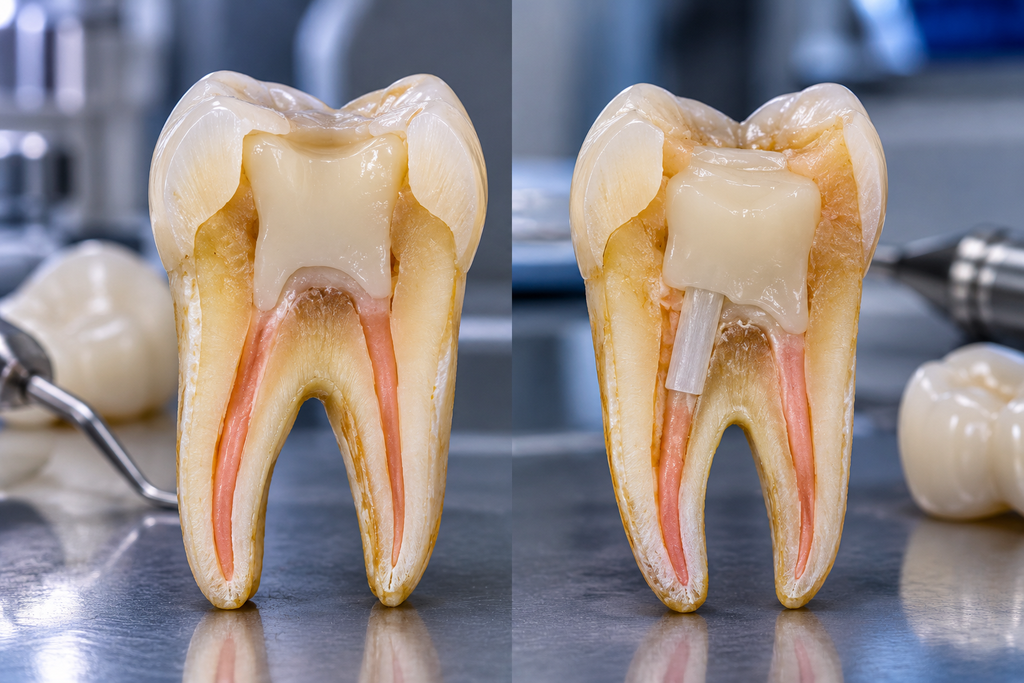
    A core buildup can be used to reconstruct the internal portion of the tooth and provide a foundation for the final restoration.

    However, this is where another important decision has to be made:

    Two-visit root canal treatment and tooth restoration workflow

    Does Every Root Canal Tooth Need a Post?

    No.

    This is one of the most important principles of the treatment protocol.

    A post is essentially a reinforcing/retentive component placed within the root canal space to help retain a core when there is insufficient remaining tooth structure.

    However, placing a post when it is not required can introduce additional structural stress.

    The protocol therefore recommends using a post only when the remaining coronal tooth structure is insufficient to retain the core. If an adhesive core can provide adequate retention, unnecessary post placement should be avoided. 10-15 Two-Visit Endodontic Work…

    This is an example of a conservative treatment philosophy:

    Conservative core restoration and selective post placement after root canal treatment

    Use reinforcement when it is necessary—not simply because the tooth has had a root canal.


    Why Is the Crown So Important After Root Canal Treatment?

    Completing the root canal does not mean the treatment journey is finished.

    A tooth that has undergone root canal treatment can remain vulnerable to fracture, particularly when substantial tooth structure has already been lost.

    This is why definitive restoration is an important part of the overall treatment plan.

    Once the core buildup is completed and the clinical situation is appropriate, the tooth can be prepared for its final crown.

    The protocol targets crown placement at approximately one week after the core buildup, helping protect the restored tooth from functional forces. 10-15 Two-Visit Endodontic Work…


    A Simple Way to Understand Our Approach

    Think of root canal treatment as a sequence rather than a single procedure:

    1. Control

    Clean the infected canals and manage infection and inflammation.

    2. Reassess

    Allow the tooth to respond and evaluate whether symptoms have settled.

    3. Complete

    Perform definitive root canal obturation when clinically appropriate.

    4. Rebuild

    Restore lost tooth structure with an appropriate core, using a post only when indicated.

    5. Protect

    Place the definitive crown to reduce the risk of fracture.

    This sequence reflects the core clinical philosophy outlined in our protocol: infection control first, conservative structural reinforcement and timely definitive restoration. 10-15 Two-Visit Endodontic Work…


    Definitive crown protecting a tooth after root canal treatment

    How Digital Dentistry Can Support Dental Treatment

    Modern dentistry has increasingly moved toward digital diagnosis, treatment planning and documentation.

    At Sri Sai Dental Clinic, our available technology includes CBCT imaging, intraoral scanners, 3D printing and digital dental workflows.

    These technologies can be incorporated into treatment planning when clinically indicated.

    For example, CBCT may provide three-dimensional information when conventional dental radiographs are insufficient for a particular diagnostic or treatment-planning question.

    Our digital capabilities are part of a broader goal: combining appropriate technology with sound clinical decision-making rather than using technology simply for its own sake.


    Why Choose Sri Sai Dental Clinic in Coimbatore?

    Sri Sai Dental Clinic is located on Avinashi Road, Coimbatore, and provides multidisciplinary dental care supported by a team that includes prosthodontic, implantology, maxillofacial, preventive and cosmetic dental expertise.

    Our approach to complex dental treatment is based on planning the restoration as part of the overall treatment—not treating the root canal as an isolated procedure.

    This becomes particularly important when significant tooth structure has been lost and decisions regarding core buildup, post placement and crown protection are required.

    For patients considering root canal treatment in Coimbatore, a detailed examination can help determine whether the tooth can be predictably preserved and what restorative steps may be necessary afterwards.


    When Should You See a Dentist?

    Don’t wait until dental pain becomes severe.

    If you experience persistent pain, discomfort while chewing, prolonged sensitivity or recurring symptoms from a previously treated tooth, a dental evaluation is appropriate.

    The earlier the problem is assessed, the sooner your dentist can determine the available treatment options.


    Conclusion: Root Canal Treatment Is About More Than Cleaning the Tooth

    A successful root canal treatment plan doesn’t end when the canals are filled.

    The treatment needs to consider:

    • Infection control
    • Symptom resolution
    • Conservative preservation of tooth structure
    • Appropriate core restoration
    • Selective use of a post
    • Timely crown protection

    At Sri Sai Dental Clinic, Avinashi Road, Coimbatore, our staged approach is designed around these principles.

    If you have been advised to undergo root canal treatment or are experiencing persistent tooth pain, contact our clinic for an evaluation.

    Sri Sai Dental Clinic – Avinashi Road, Coimbatore

    Phone: +91 94427 09568

    Website: www.srisaidentalclinic.com

    www.srisaiclinic.com

  • Are Dental Implants Worth It? Benefits, Cost and Long-Term Value in Coimbatore

    Are Dental Implants Worth It? Benefits, Cost and Long-Term Value in Coimbatore

    If you are missing one or more teeth, you may be wondering whether dental implants are really worth the cost and treatment time. For many patients, the answer is yes. Dental implants offer a strong, natural-looking, long-term solution that can improve chewing, speech, comfort, and confidence.

    At Dr. Vidhiyasagar’s Sri Sai Dental Clinic in Coimbatore, we help patients understand their options clearly so they can choose the treatment that suits their oral health, lifestyle, and budget. You can explore our complete Services or read more Implants Articles for related guidance.

    What Are Dental Implants?

    Dental implants are artificial tooth roots, usually made of titanium, that are placed into the jawbone to support a replacement tooth or bridge. A complete implant restoration usually includes:

    • A titanium implant post placed in the jawbone
    • An abutment that connects the implant to the replacement tooth
    • A crown that looks and functions like a natural tooth

    Unlike removable dentures, implants are fixed in place and designed to feel more like natural teeth. In more complex cases, patients may also benefit from options such as Full Mouth Rehabilitation.

    Dental implant structure showing titanium post, abutment and crown

    Why Dental Implants Are Worth It for Many Patients

    Long-term value

    Dental implants can last for many years and often much longer than other tooth replacement options when cared for properly. While bridges or dentures may need more frequent replacement or adjustment, implants are designed as a durable long-term solution.

    Natural look and feel

    Implants are made to blend with your smile and restore normal function. Many patients find they can eat, speak, and smile more comfortably after treatment.

    • They look similar to natural teeth
    • They feel stable while chewing and speaking
    • They help restore confidence in daily life

    Helps reduce bone loss

    When a tooth is missing, the jawbone in that area can begin to shrink over time. Dental implants help stimulate the bone, which can support facial structure and oral health.

    Dental implants helping support jawbone and facial structure after tooth loss

    Better comfort and chewing

    Because implants are fixed, they do not move like loose dentures can. This can make everyday eating more comfortable and help patients return to a wider range of foods.

    Are Dental Implants Expensive?

    The initial cost of dental implants is usually higher than some other tooth replacement options. However, cost should be viewed alongside durability, comfort, function, and long-term maintenance.

    For many patients, implants offer better long-term value because they are designed to last longer and help preserve the jawbone. The exact cost depends on factors such as the number of missing teeth, bone condition, need for grafting, and the type of restoration used. If you need the final replacement tooth after implant placement, you may also want to understand Crowns and Bridges.

    If you want to learn more about treatment options, visit our Dental Implants page.

    Are Dental Implants Painful?

    Modern implant treatment is planned carefully to improve comfort and precision. The procedure is usually done under local anesthesia, and many patients say it is easier than they expected.

    • Done under local anesthesia
    • Highly precise using advanced technology
    • Focused on patient comfort throughout treatment

    At our clinic, digital planning and advanced surgical techniques help us deliver accurate, patient-focused care. Patients with anxiety may also benefit from learning about our Conscious Sedation options.

    Dental implant treatment at Sri Sai Dental Clinic in Coimbatore

    Who Is a Good Candidate for Dental Implants?

    You may be a suitable candidate for dental implants if you:

    • Have one or more missing teeth
    • Have healthy gums
    • Have enough bone support or are suitable for bone grafting
    • Want a fixed and long-term replacement option

    A detailed consultation, clinical examination, and imaging help determine the right treatment plan for your case. If you have severe bone loss, you can also learn about Zygomatic Implants and our advanced Technology.

    Why Choose Sri Sai Dental Clinic for Dental Implants in Coimbatore?

    Dr. Vidhiyasagar’s Sri Sai Dental Clinic offers advanced implant care with a caring and professional approach. Our team focuses on precision, safety, and long-term function.

    • Experienced implant-focused care
    • Digital planning and advanced technology
    • Personalized treatment planning
    • Convenient location on Avinashi Road, Coimbatore

    You can also learn more about our doctor on the Dr. Vidhiyasagar page and explore our Technology page to understand how digital dentistry supports treatment accuracy.

    Final Answer: Are Dental Implants Worth It?

    If you want a replacement option that looks natural, feels stable, supports oral health, and offers long-term value, dental implants are worth considering. They are not just about replacing missing teeth. They can also help restore confidence, comfort, and quality of life. If you are ready to discuss your options, visit our Contact page or read patient feedback on our Reviews page.

    Frequently Asked Questions

    Are dental implants safe?

    Yes. Dental implants are widely used and have a high success rate when treatment is planned and performed properly.

    How long do dental implants last?

    With good oral hygiene and regular dental follow-up, implants can last for many years and often much longer.

    Can dental implants fail?

    Implant failure is uncommon, but it can happen due to infection, poor oral hygiene, smoking, or certain medical factors. Regular follow-up helps reduce risk.

    How long does the dental implant process take?

    The timeline varies by case. Some patients may need a few months for healing, especially if bone grafting or multiple implants are involved.

    Book a Consultation in Coimbatore

    If you are considering dental implants in Coimbatore, contact Dr. Vidhiyasagar’s Sri Sai Dental Clinic for a consultation and personalized treatment plan.

    Call 9442709568 or visit our Contact page to book an appointment.

  • Advanced Dental Implants and Complete Smile Care in Coimbatore

    Welcome to Sri Sai Dental Clinic

    At Dr. Vidhiyasagar’s Sri Sai Dental Clinic, we believe every patient deserves clear guidance, comfortable care, and treatment planned with precision. Located in Goldwins on Avinashi Road, Coimbatore, our clinic is known for advanced implant expertise along with complete dental care for children, adults, and seniors.

    Led by Dr. P. Vidhiyasagar, MDS Prosthodontist, Implantologist, and Zygomatic Implant Specialist, our practice combines clinical experience with modern digital dentistry. Whether you need a routine dental visit, smile improvement, or support for a complex full mouth rehabilitation case, our goal is to help you feel informed, comfortable, and confident at every step.

    What Makes Our Clinic Different

    Care Designed Around Patients

    Dental care is not only about treating teeth. It is also about understanding the person behind the smile. Some patients visit us for long-term tooth replacement, some want a straighter smile, and others simply want a trusted clinic for their family’s routine dental needs. We take time to explain options, answer questions, and recommend care based on each patient’s goals, comfort, and oral health condition.

    Our approach is simple: advanced treatment when needed, honest guidance always, and a caring experience throughout the journey.

    Visit Us in Coimbatore

    If you are looking for advanced dental implants in Coimbatore or a clinic that offers complete dental care under one roof, Sri Sai Dental Clinic is here to help. From preventive care to complex restorative treatment, we are committed to helping patients restore comfort, function, and confidence with a caring, professional approach.

    To book an appointment, call 9442709568 or visit our Contact page, or come to No. 2, Vetrivel Nagar, Civil Aerodrome Post, Avinashi Road, Goldwins, Coimbatore 641014.